
Introduction:
The SW products applied as foliar treatments help optimize enzyme development. These products are designed, among other things, according to the work of Francis Chaboussou (research director at INRAE).
This results in:
- Very good conversion of sugars into lipids, carbohydrates, starches, etc.
- Conversion of amino acids into protein (proteosynthesis).
Beyond the improved production of dry matter, it is observed that plants are no longer appetizing to insect pests (stink bugs, corn borers, aphids, etc.) insofar as there are no free and soluble sugars, nitrogen, and amino acids in the sap.
To verify this theory, Jean Paul Raffy, a farmer in Lot-et-Garonne, carried out counts in his municipality on 4 maize plots that followed different protocols.
- Plot No. 1: managed conventionally with an insecticide treatment against corn borers
- Plot No. 2: managed conventionally with no insecticide, plus SW SOL, SW Plants, SW Proteo+ and Vitamin C
- Plot No. 3: managed conventionally with no insecticide
- Plot No. 4: managed conventionally with no insecticide
In each plot, counting was carried out on 130 plants.
Counting results:
| Number of attacked plants out of 130 | Percentage | |
|---|---|---|
| Plot No. 1 | 9 | 7% |
| Plot No. 2 | 3 | 2.3% |
| Plot No. 3 | 21 | 16.1% |
| Plot No. 4 | 22 | 16.9% |
Conclusion:
With only 2.3% of attacks, Plot No. 2, without insecticide but receiving a natural treatment with SW products + Vitamin C, is the least attacked. The transformations of sugars and amino acids made the maize plants less appetizing to pests. This test corroborates results obtained on other crops and types of insect pests such as stink bugs on kiwifruit or tomatoes, aphids on sugar beets, etc.
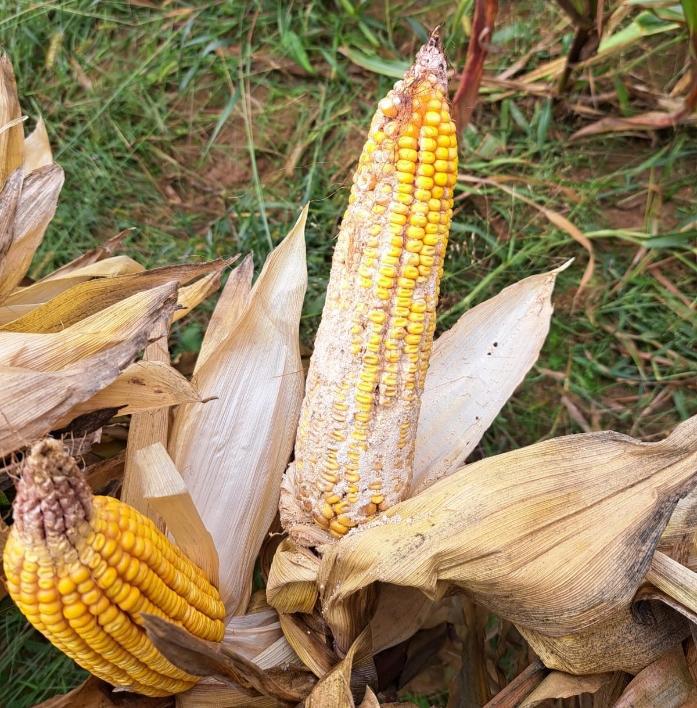
Example of an ear damaged by the corn borer in plot No. 3.